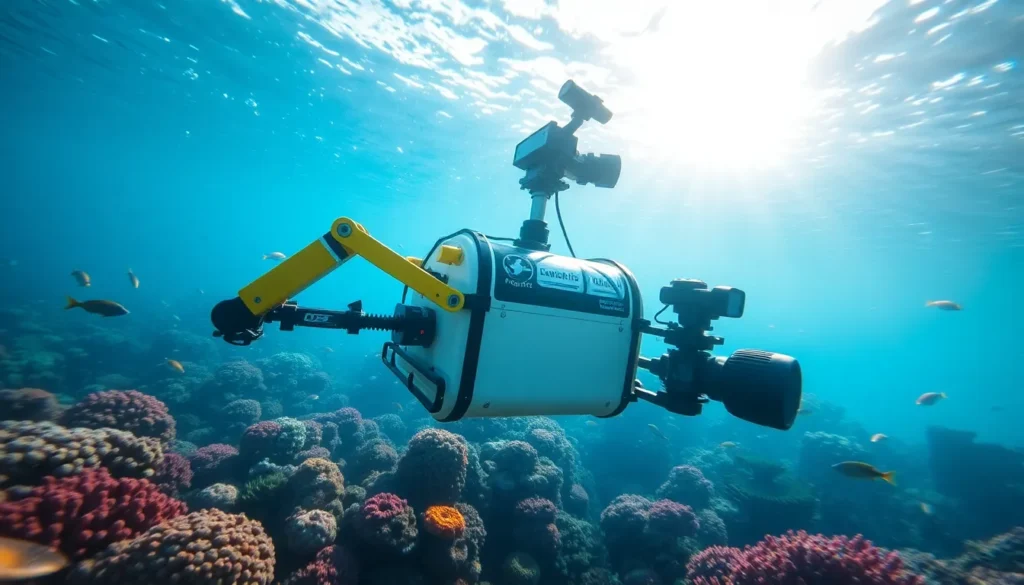
Imagine a world where robots explore the depths of the ocean while humans sip coffee on dry land. Underwater robots are making this dream a reality, diving into the mysterious blue to uncover secrets that have eluded us for centuries. From searching for shipwrecks to monitoring marine life, these high-tech marvels are the ultimate aquatic adventurers.
Overview of Underwater Robots
Underwater robots, also known as remotely operated vehicles (ROVs) or autonomous underwater vehicles (AUVs), play a crucial role in marine exploration. These machines operate in diverse marine environments, from shallow coastal waters to the deep ocean trenches. Applications range across various fields such as oceanography, environmental monitoring, and resource exploration.
ROVs typically require human operators, who control them from a surface vessel. Equipped with cameras and robotic arms, ROVs enable researchers to conduct tasks like collecting samples and inspecting underwater structures. AUVs, on the other hand, function independently, gathering data on currents, temperatures, and marine species without direct human control.
Navigation technologies enhance the capabilities of underwater robots. Many rely on GPS systems, sonar, and inertial navigation to maneuver through complex underwater terrains. Advanced sensors also provide real-time data, contributing to research and environmental monitoring initiatives.
Significant advancements in battery technology allow for longer missions and greater operational depth. Enhanced imaging systems facilitate detailed observations of marine ecosystems. Both ROVs and AUVs encourage collaboration among experts, enabling scientists to study phenomena such as coral bleaching and oil spills more effectively.
Notably, underwater robots aid in archaeological investigations, assisting in the search for shipwrecks and ancient artifacts. Their ability to operate in hazardous conditions minimizes risks to human divers. As technology progresses, the capabilities of underwater robots continue to expand, revealing the wonders of the ocean and addressing pressing challenges in marine conservation.
Types of Underwater Robots
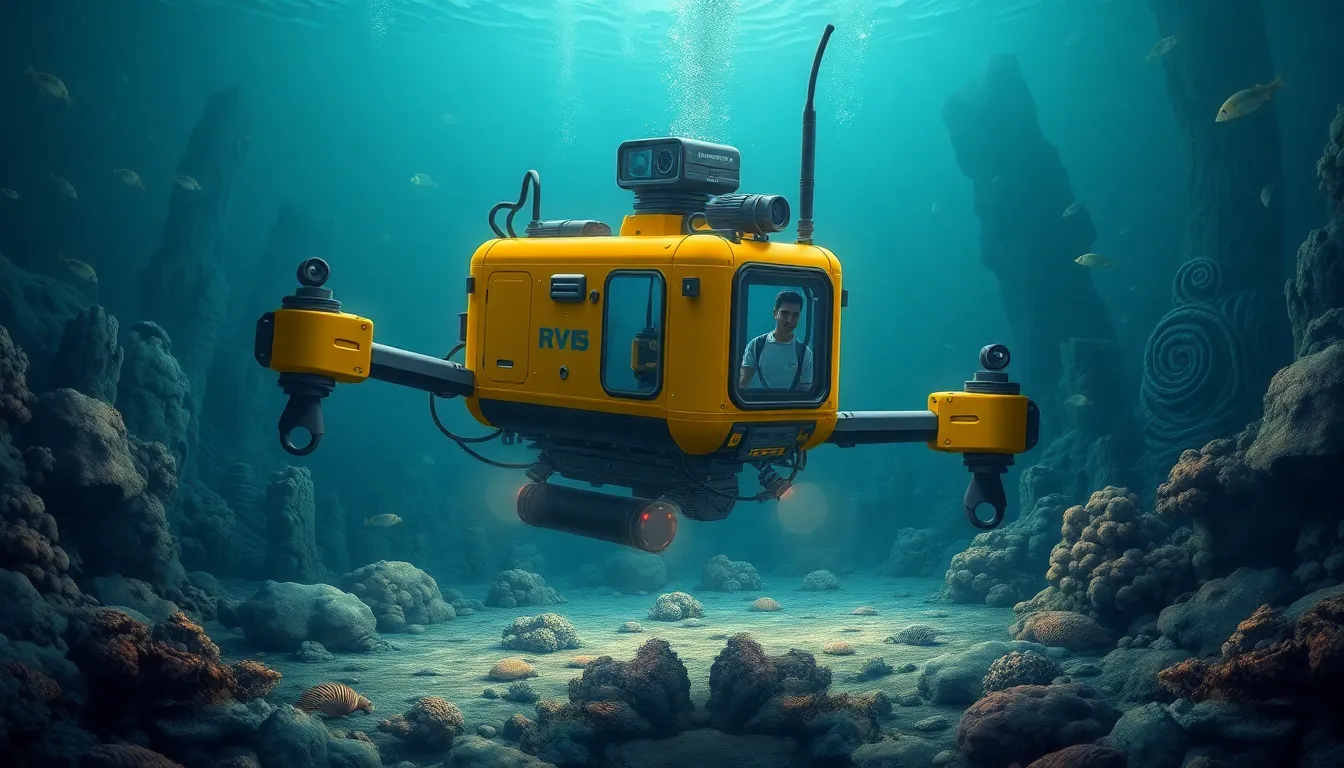
Underwater robots fall into two primary categories: remotely operated vehicles (ROVs) and autonomous underwater vehicles (AUVs). Each type serves distinct functions, enhancing exploration and research in marine environments.
Remotely Operated Vehicles (ROVs)
ROVs are operated by human controllers often aboard ships. Equipped with high-definition cameras and robotic arms, these vehicles perform tasks such as underwater inspections and sample collection. Operators guide ROVs through real-time video feeds, allowing precise maneuvering in complex underwater terrains. Several industries utilize ROVs, including oil and gas, for maintenance and repair operations. Research institutions also employ ROVs to gather data on marine species and habitats, contributing to environmental conservation efforts. The flexibility of ROVs makes them essential tools in underwater exploration.
Autonomous Underwater Vehicles (AUVs)
AUVs function independently, relying on pre-programmed routes or real-time navigation systems. These robots collect data on various oceanic conditions, including temperature, salinity, and currents. Equipped with advanced sensors, AUVs can cover large distances, making them ideal for mapping ocean floors and conducting marine research. Many scientific organizations utilize AUVs for tasks such as monitoring coral reefs or tracking migratory patterns of marine life. Their ability to operate without direct human intervention allows for prolonged missions that enhance our understanding of underwater ecosystems. The efficiency of AUVs broadens the scope of underwater exploration significantly.
Applications of Underwater Robots
Underwater robots serve various essential functions across multiple industries, enhancing human understanding and interaction with aquatic environments.
Ocean Exploration
Ocean exploration utilizes underwater robots to reach depths conventional methods can’t achieve. Autonomous underwater vehicles (AUVs) collect data on temperature, salinity, and currents, providing invaluable insights into marine ecosystems. These vehicles navigate vast distances, enabling the mapping of ocean floors with exceptional accuracy. Remotely operated vehicles (ROVs) expand on this by capturing real-time video footage and images, facilitating the study of underwater geology and marine species. Technologies such as sonar and imaging systems improve both exploratory efficiency and effectiveness by capturing detailed information.
Environmental Monitoring
Environmental monitoring employs underwater robots to track changes in marine ecosystems. These robots analyze water quality by measuring parameters like oxygen levels and pollutants. They play a vital role in monitoring coral reefs and detecting shifts caused by climate change or human activity. ROVs and AUVs also gather baseline data that supports conservation efforts, providing insights into species behavior and habitat health. Collaborations between scientists benefit from these observations, fostering a deeper understanding of environmental dynamics and threats faced by marine life.
Search and Recovery Operations
Search and recovery operations heavily depend on underwater robots for efficiency and safety. When it comes to identifying shipwrecks or retrieving lost objects, ROVs are equipped with robotic arms to perform delicate tasks underwater. These machines mitigate risks to human divers by operating in hazardous environments, such as deep ocean trenches or contaminated waters. Detailed imaging and sonar capabilities support search efforts, allowing for precise localization of items. Successful recovery missions often depend on the advanced technologies integrated into these underwater robots, making them invaluable assets in nautical salvage and archaeological investigations.
Advantages of Using Underwater Robots
Underwater robots provide significant advantages across various fields. Enhanced safety is a major benefit, as they operate in hazardous environments without putting human lives at risk. By utilizing remotely operated vehicles (ROVs) and autonomous underwater vehicles (AUVs), researchers can access deep-sea regions that are otherwise unreachable.
Cost efficiency also plays a crucial role. These robots reduce the need for extensive human divers and expensive manned submersibles. Expenses associated with training divers and maintaining diving equipment decrease significantly through automation.
In terms of operational capabilities, underwater robots possess the ability to collect data continuously and consistently. AUVs navigate pre-programmed routes, gathering data on ocean conditions such as temperature and currents across vast distances. ROVs provide real-time imaging, allowing immediate analysis of underwater structures and marine species.
Advanced technologies further enhance their effectiveness. Integration of GPS and sonar systems improves navigation accuracy, while innovations in battery capacity extend mission durations. Increased mission lengths allow for more comprehensive data collection during a single deployment.
Flexibility in application contributes to their widespread use. In archaeology, ROVs explore shipwrecks and underwater ruins, enabling detailed surveys without disturbing fragile sites. For environmental monitoring, underwater robots track changes in ecosystems, contributing to critical studies on coral bleaching and pollution.
Collaboration among scientific teams improves with the use of these robotic technologies. Researchers can share data collected by underwater robots, fostering collective efforts toward marine conservation. Ultimately, these advantages position underwater robots as indispensable tools in advancing knowledge and understanding of the ocean’s mysteries.
Challenges in Underwater Robotics
Underwater robotics faces numerous challenges that impact their design and functionality. High pressure conditions in deep waters present significant engineering obstacles. Increased pressure can affect the integrity of materials, necessitating the use of specialized components to ensure durability.
Communication issues arise due to water’s density, limiting traditional radio frequency signals. This limitation requires underwater robots to rely on acoustic signals, which often results in reduced data transmission rates. Navigation presents another challenge, as GPS signals do not penetrate water effectively, making real-time positioning complicated. Alternative methods, such as inertial navigation systems and sonar, need to be utilized for accurate localization.
Power supply limitations can constrain mission durations. Many underwater robots depend on batteries, which may not provide enough energy for extended operations. Innovations in battery technology, such as energy-dense lithium-ion batteries, continue to be explored to mitigate this issue.
Environmentally induced factors also affect the performance of underwater robots. Marine life, varying temperatures, and currents can hinder operation. For instance, strong currents might disrupt stable navigation or affect the robot’s ability to complete its assigned tasks.
Cost implications represent a final challenge for widespread adoption. Developing and maintaining sophisticated underwater robots can be expensive. Budget constraints often limit exploration initiatives despite the long-term value these technologies provide for research and monitoring.
Addressing these challenges requires ongoing collaboration between engineers and scientists. Advancements in materials science, energy storage, and navigation technology remain crucial for improving the capabilities of underwater robots. Through innovation and research, the future of underwater robotics offers promising solutions to current limitations.
Underwater robots represent a transformative force in marine exploration and conservation. Their ability to navigate challenging environments while collecting valuable data makes them indispensable in various industries. As technology continues to evolve, these machines will tackle existing challenges and enhance their operational capabilities.
The future of underwater robotics is bright, with ongoing advancements in materials, energy storage, and navigation systems. This progress promises to unlock even deeper ocean mysteries and support critical environmental efforts. By bridging the gap between human knowledge and the ocean’s depths, underwater robots are set to play a pivotal role in understanding and preserving marine ecosystems for generations to come.